My Lifelong Passion for Books

As Valentine’s Day is almost upon us I considered writing of love or other obvious themes for the day, such as flowers, hearts or chocolate.  But I realised that most of my thoughts on these subjects would be covered by other people, especially at this time of year.  Whilst I was still considering what to write about, I received an email at work which reminded me of the Quick Reads Initiative and the recent 2012 releases, this in turn reminded me of World Book Day and got me thinking of my lifelong passion for books and reading.

In my teens and early twenties the novels I read were mainly science fiction and fantasy but I also read about nature, science, strange facts, unexplained phenomena and other related subjects.  One of my favourite magazines at the time was Omnium which was a mixture of science fact and fiction.  My choice of novels expanded to include history, philosophy, world views; any reading that stretched my mind and got me thinking.

By the time I reached my thirties, my reading had further diversified to include books and magazines on photography (digital and film) so that I could understand the principles and explore the different techniques.  I also read computer manuals from cover to cover (almost) to teach me how the computer operating system worked and how to write code to magically produce web pages.

In my forties I gained an interest in family history, stately homes, castles and gardens and started to read about those.  I always pick up the guidebook for the places I visit, to give me background information which enhances my enjoyment of the visit.  Whenever I visit another country I pick up a travel guide book to give a sense of history and culture, so I can enjoy the country even more.

My recent readings have mostly been on the theme of history, science, philosophy and world views, interspersed with one or two mystery thrillers.  My readings always include alternative ideas to the accepted view of the world, which allows me to expand my horizons.

I knew I would enjoy the first book that was chosen for the Vision & Verb book group, especially because I was sure that when  I had finished it ( which I have now ) I would love to hear what the other V&V ladies had to say and discuss the themes and ideas with them.  For me, one of the best things about books is being able to discuss them, or what you have learned from them, with other people.

I think other people would describe my reading as eclectic/eccentric, maybe it is…

I will leave you to wonder which book I am currently reading…

The Wrekin Hill

The Wrekin is a prominent landmark located near the center of the county of Shropshire.  According to ‘The handbook of the Wrekin’ (a small definitive guide to ‘The Wrekin’ by R.E. Davies a well known local historian), published in 1895 ‘the Wrekin’ is considered to be the highest mountain in Europe in proporotion to the circumference of its base. It is situated in beautiful countryside and from its summit you can see for miles.

The Wrekin is a  Scheduled Monument and as such is an example of a nationally rare monument type. At its summit is a large and prominent hill fort that possesses two lines of ramparts which follow the countours of the hill, although they are very much eroded now. The oldest of the Wrekin’s geology was formed 680 million years ago and fossils such as trilobites from the Precambrian and Cambrian periods have been found nearby. Archaeological excavations have shown evidence of Bronze and Iron Age domestic occupaton spanning several hundred years. The handbook of the Wrekin states the outer vallum measured at least a mile and was capable of housing twenty thousand men. The entrance to the outer vallum is known as Hell Gate and the inner entrance is known as Heaven Gate.

It is thought that the Roman military campagin forced the hill fort’s abandonment in the mid first century AD. The Romans finally settled in Viriconium and the settlement spread for miles including parts of what now is the Attingham Park estate. One third of the Roman city of Viriconium whose public baths have been excavated can be seen at Wroxeter which is close to the Wrekin.

Local folklore tells us that a giant had a grudge against the people of Shrewsbury and how he set off to flood the town and kill off its inhabitants. He collected a spade full of earth and headed towards the town. When he arrived near the town of Wellington he met a cobbler who was returning from Shrewsbury market with a sack full of shoes that needed repairing. The giant asked the cobbler for directions to Shrewsbury and told the cobbler of his plan. The cobbler advised that it was a long way to Shrewsbury and said that he had worn all the shoes out in his sack on the way from Shrewsbury. This caused the giant to abandon his plan, so he dumped the earth on the ground beside him, where it became the Wrekin hill. The giant then scraped the mud off his boots and this formed the smaller Ercall (prounounces Arcle) hill.

A local phrase “all round the Wrekin to get to the Ercall” is used to express that you are going “the long way round”.  Another local phrase is “to all friends around the Wrekin” which is used as  a toast especially at Christmas and New Year.

Some claim that the Wrekin is the inspiration for Middle Earth, it certainly has that feel about it and J.R.R. Tolkein did enjoy walking on the hill.

A New Year’s Eve Toast

New Years Eve is often a time for family and friends to get together so that they can see out the old year and greet the new one.

As midnight approaches it is not uncommon for a bottle of champagne to be opened to toast in the New Year, usually accompanied by Jules Holland’s Hootenanny on the BBC.  I am reminded of a bottle of Champagne that has been resting in my wine rack since 2005.  It is a remnant of one of my formerly annual coach trips to the continent which usually occurred in early November around the time of my birthday.  In 2005 we visited the historic town of Rheims and one of the excursions was to Maison Ruinart.

Maison Ruinart was established in 1729 by Nicolas Ruinart and is the oldest established champagne house.  We were taken on a tour of the cellars and were told of the fine art of producing champagne.    As the wine ferments and matures it is housed in underground “Crayères”.  These are chalk tunnels from former Gallo-Roman chalk quarries underneath the city of Rheims that were acquired by Ruinart in 1768.  Their depth is up to 38 metres and there are 8 kilometres of galleries on three levels.  The Crayères offer the benefits of a stable temperature, no vibrations and perfect humidity to allow the wine to ferment and slowly mature.  The wine bottles are painstakingly turned a quarter of a turn periodically by hand.

The tour ended with a generous tasting of three different types of Ruinart champagne.  I was particularly taken with their Rose champagne, so I indulged and came away with two bottles.  One was opened on Christmas day that year and the other was saved for a special occasion.  The last few years have had their ups and downs so those special occasions didn’t happen in the way they perhaps should have.  My becoming a lady of a certain age, last November would have been the perfect occasion but due to being away in Bruges I completely forgot about the champagne.

I know our time zones are all different so midnight will bring in the New Year at different times for each of us but what better occasion than tonight, ‘New Years Eve’, to crack the bottle open as midnight turns in the UK.   I will raise my glass to friends, old and new, and of course not forgetting absent friends.

CHEERS!!  I raise my glass to you.  Thank you for sharing life’s journey with me, I hope that any troubles from 2011 will fade into distant memory and I wish you, your family and friends a happy, healthy and peaceful 2012.

xxx

Tree of Light

At the beginning of December many Rotary clubs throughout the United Kingdom launch their annual ‘Tree of Light’.  The concept of the ‘Tree of Light’ was introduced into Shropshire from South Africa in the 1990s by a county Rotarian. For many years, since its inception, my father was a member of the small committee of Rotarians that run the Telford ‘Tree of Light’; these Rotarians are from the four Rotary clubs of Telford.

The name and symbolism of the ‘Tree of Light’ reminds us that there can be light and hope even in bleak circumstances.  The main aim of the ‘Tree of Light’ is to serve the public and the community which is at the heart of the Rotary organisation whose motto is ‘service above self”.

People are invited to sponsor a light on the tree in memory of a loved one (or a cause dear to them) and the monies raised are divided between local charities. The commemoration of a loved one around the tree provides a sense of wellbeing to those who take part.

The names of the nominees are displayed around the base of the tree, on the ‘Tree of Light’s web page and also published in the local newspaper.  There is always one main charity to which half of the monies raised is donated; the other half is split equally between the Rotary clubs that administer ‘The Tree of Light’, for them to donate to a local charity of their choice.  This year the charities are the Telford Hospice, Landau (supported employment), Hope House Children’s Hospices, Marie Curie Cancer Care and the Princess Royal Hospital Breast Cancer Support Group.

My father spent many a long hour in the run up to Christmas attending committee meetings or sitting upstairs at home processing names and lists for publication under the tree and in the local newspaper.  His involvement included receiving phone calls from some of the sponsors who had queries   about their request.  He loved the premise and the concept of the ‘Tree of Light’ and that it provided a treasured service to people at this particular time of year.

Christmas is a time for families and friends and also a time for remember absent friends and family.  The ‘Tree of Light’ is a welcome opportunity to remember and cherish absent friends, it is only fitting that my father’s name now appears amongst those names that, alongside his fellow Rotarians, he helped commemorate over the years.

York Minster

Anybody who has visited York will be impressed by the magnificence of York Minster which (as we see it today) took around 250 years to build.  It is the largest medieval Gothic cathedral in Europe.  Within and beneath the Minster are traces of every age from the Roman occupancy onwards.  The Minster was originally Roman Catholic but converted to the Church of England after the break from Rome, which was initiated by Henry VIII in 1534.  Mynster was the Anglo Saxon name for a missionary church, a church built as new centre for Christian worship.  In addition to being a Minster the church at York is a Cathedral.  A cathedral is the church within a diocese which houses the “cathedra” or ‘chair’ of the bishop.

The first Minster was wooden and built for the christening of the Anglo Saxon King Edwin of Northumbria in 627.  A few years after his christening Edwin ordered that the church be rebuilt in stone.  A small stone church was erected on the site of the original wooden structure, which over time was enlarged.  The new structure managed to survive the Viking age only to be damaged by fire in 1069 when the Normans took control of the city.

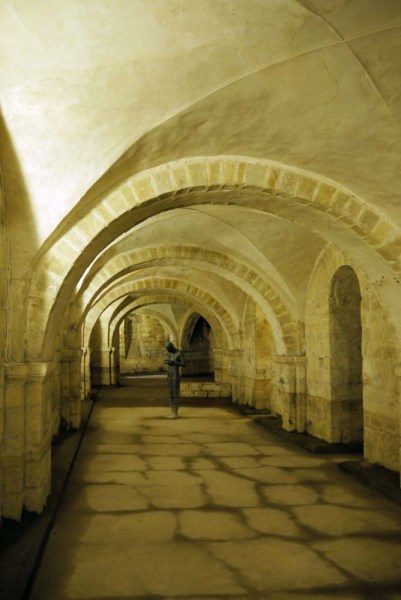
The Normans decided to build a new Minster in a different location.  In 1080 Thomas of Bayeaux became Archbishop and started to build a cathedral which was completed after his death in around 1100.  The columns from this structure can be seen today in the undercroft beneath the current Minster.  I will come back to the undercroft later.

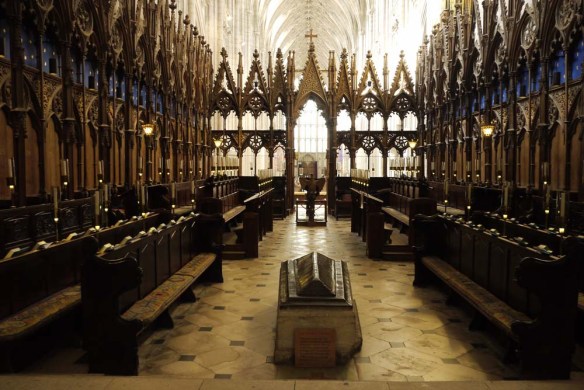
During the mid twelfth century the Norman church was enlarged to the East and the West.  Walter Gray became Archbishop in 1215 and was responsible for transforming the Norman church into today’s Minster and over time the nave, Lady Chapel and quire were added.

The central tower collapsed in 1407 and was not completely rebuilt until 1433.  Following the rebuilding of the tower the western towers were added, completing the Minster in 1472.

The Minster has suffered other damage over the years.  In February 1829, Jonathan Martin deliberately set fire to the quire.  The fire destroyed the east end roof and timber vault and also all of the wooden furniture within the quire.  Then, just eleven years later and accidental fire destroyed the nave and roof vault.  In more recent times (1984) another fire broke out in the south transept.  This time it was natural causes; a lightning strike.  It took 4 years to repair the damage.

The Minster is currently part way through the five-year ‘York Minster Revealed‘ project.  The Heritage Lottery Fund has issued a grant to enable expansion of training in the specialist skills of stone-masonry and stained glass conservation.  These skills are being used to repair and restore the stonework and stained glass on the east front of the Minster.

When I visited the Minster recently I was able to see the stonemasons working away at their craft, outside the Minster in the stone yard.  On my previous visit last year there was a display of some of their detailed work within the Minster.  I am sure by now this has been incorporated into the newly repaired parts of the Minster’s stonework.

There are many stained glass windows within the Minster.  The oldest complete one dates back to around 1260.  The great east window which has been removed as part of the current restoration is the world’s largest area of medieval stained glass in a single window.  It depicts the beginning and the end of the world using scenes from the biblical books of Genesis and Revelation.  Whilst it is being restored it has been replaced by a nearly full-sized digital photograph which is the largest of its kind in the world.

I mentioned that I would talk more about the undercroft, which has some fascinating historical displays.  In the 1960s the central tower was in danger of collapse and required work to shore up the foundations.  The workers carrying out excavations in the undercroft found remains of the buildings that had previously existed on the site, along with artefacts, which are now on display alongside the archaeological remains of both the Roman principia building and the Norman cathedral.  The undercroft also houses the treasures and jewels of the archbishops.  The crypt is still used occasionally for special church services.

Attingham Park

When I have a bit of spare time on my hands I often choose to visit Attingham Park and take a relaxing stroll around the parkland.  The estate is centred around the river Severn and the river Tern and is nearly 4,000 acres which is about half the size it would have been in the 1800s.

The mansion itself was built between 1782 and 1785 by Noel Hill; it replaced Tern Hall which was the original house on the site. Noel was a successful politician for which he was rewarded financially and given the title of 1st Lord Berwick in 1784.  Not all of the Lords Berwick were quite so successful as Noel with the second Lord becoming bankrupt and the 6th and 7th Lords severely neglecting the estate which led to the 8th Lord having to sell off parts of the estate to enable the house to be restored.

 There are several walks to choose from in the 370 acres of woodland within the estate.  These woodlands are home to many species of wildlife including otters, dragonflies, as well as many species of birds and flowers.  In late winter there are delightful patches of snowdrops followed by bluebells in spring.

The estate is also home to around 200 Fallow deer, which can be seen close up and feeding during the months from October to March.  The deer park walk takes you past a 650 (!!!) year old Repton oak which is one of many ancient trees that can be seen in the woodlands there.

One of my favourite parts of the estate is the walled garden which is in the progress of being restored.  The restoration commenced in 2008 and so far half of the garden is back in production.  The garden, which is more than two acres was built in the 1870s and would have provided food for the whole household.  During the 20th century the garden fell gradually into decline. The fruit trees had been ripped out, the well filled in so that could be turned into a football pitch.  Nowadays the food produced in the garden is used for soups and salads in the tearoom.  Some of the produce is also sold in the national trust shop.

Just outside the walled garden is a historically-listed bee house complete with traditional straw skeps which are fully occupied by bees.  It is one of only two known Regency bee houses in the country.

People have been living in the area of the estate for about 4,000 years since the bronze age.  There are no less than seven Scheduled Ancient Monuments on the estate.  These include iron age settlements, saxon palaces, roman forts  and one third of the Roman city of Viriconium whose public baths have been excavated and can been seen at the nearby site of Wroxeter. Ancient crop marks and a medieval roadway can also be found within the estate.

On his death the Thomas 8th Lord (Berwick) bequeathed the estate to the National Trust.  He described his gift of Attingham as for public benefit.  I can’t argue with him there.  The estate has many educational opportunities for both adults and children and many people take the opportunity to visit and enjoy the estate.

Rest a While With Me

I don’t know if it is just me but time seems to be speeding up and rushing by.  Each year seems to go by faster than the previous one and I seem to make fewer achievements for this passing of time.  I have too many tasks and too many demands, but not enough time for them all.

The phone rings at any time of day or night, interrupting my thoughts and slowing me down whilst the time still flashes by.  Other peoples schedules encroach and my plans get disjointed and out of kilter.  I always seem to be waiting for something or someone which leaves no time to plan or think clearly.  Too many things to take care of and not enough time to do all those things.

To make time slow down, I take time out, step out of life and time.  I visit a garden, soak up some history, or walk by a river or through the woods; always with camera in hand; you never know when the perfect photo opportunity might show up.

Along the way I look for the perfect bench so that I can take time to sit and rest a while, stepping out from the humdrum and escaping for a while.  I sit amongst nature and think, reflect, plan, stargaze, dream and reminisce.  In this place where time slows down I forget about the day-to-day hustle and bustle and contemplate the wonders of nature and my place within it.  I watch and listen and tune back in, once again at peace with my place in the world.

I invite you to sit and rest a while with me…

But before you sit down, please remember to turn your mobile phone off; we don’t want to be disturbed from our reveries.